

ExclusiveTaryn ParisMon 17 Aug 26
Density Grounded: Flight Path Height Caps Cast Shadow over Sydney Housing Targets

No stranger to pushing a barrow uphill, Conquest boss Michael Akkawi is on a mission for what he sees as more sensible height limits on Sydney’s flight paths.
The brickies’s labourer-turned-developer knows that the rubber is unlikely to meet the tarmac in his own lifetime, but says something has to give.
“We’re going from having problems in the ground to having problems in the sky,” Akkawi says.
The Sydney developer is lobbying federal and state governments to redraw six-decade-old flight path height rules that he says are preventing tens of thousands of homes rising on the city’s most well-located land.
And the rules are showing their age, Akkawi says, written before GPS-guided aircraft existed, but continuing to inform how high developers can build near flight paths.
An arbitrary ceiling
Akkawi argues that whereas a red beacon atop a building once mattered for safety, today’s aircraft operate with far greater precision at altitudes that leave plenty of clearance above rooftops.
“The experts who we’ve engaged … tell us the planes are at 500m up. We’re at [30m] and we’re saying, why can’t we go to 50m?” he says.
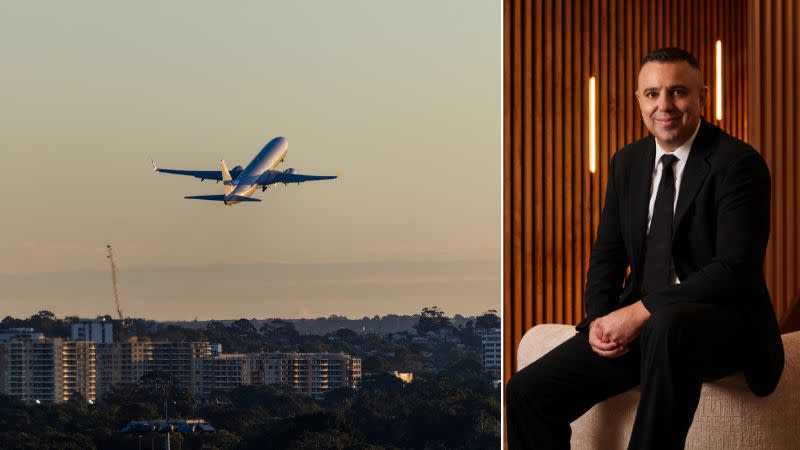
He’s engaged experts and aviation consultants to build a case study for government, arguing that lifting the height limit across the Sydney basin—even by 10 to 30 metres in infill suburbs—could unlock housing at a scale current modelling struggles to capture.
Conquest’s own Sydney Metro infill projects, he says, are directly capped by the rules. And while it’s not preventing his projects getting out of the ground, Akkawi says it is constraining the number of homes that can be built in the capital.
But Akkawi concedes the numbers are hard to pin down. What’s clear is the disparity he points to on the ground: apartment towers of 25 to 30 storeys are rising in Green Square, while sites a few streets away are capped around 14 storeys.
The economics of an extra storey
Akkawi frames the issue as much a feasibility problem as one of planning.
Construction costs have roughly doubled in the past five years. Akkawi says yield needs to keep pace—a site that once supported 100 apartments now needs more like 200 for the project to stack up.
“If you go to a developer and say, ‘your building’s at 20m, now you can go to 40m,’ his cost per site just dropped by half. The chance of his project getting built has doubled,” he says.
He also points to design upside. Taller, slimmer towers on the same footprint could free up wider ground-plane public space, rather than the current pattern of squat buildings maximising footprint to compensate for capped height.
Areas affected by flight path constraints include Annandale, Leichhardt, Petersham and Stanmore in the Inner West, as well as parts of Kingsford, Rockdale and the southern edges of the City of Sydney.
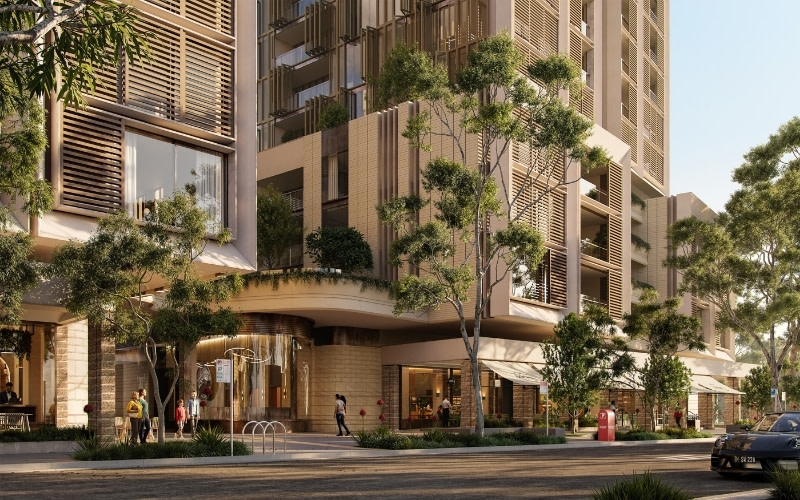
Conquest made a submission to the Productivity Commission Inquiry calling for a co-ordinated, evidence-based review of whether these protections still reflected modern aircraft performance, and whether it is costing Sydney thousands of new homes in the suburbs earmarked for growth.
A hot potato issue
Akkawi says raising the issue with the state has repeatedly been met with the same response: it’s a federal matter, tied to the Commonwealth’s aviation safety framework rather than state planning policy.
Conquest has since taken the case directly to Canberra.
Complicating the picture, he says, is that Sydney Airport itself is privately operated—owned by Macquarie-led investors—and has no direct stake in the state’s housing targets, meaning there’s little commercial incentive on the airport side to push for a review.
In his view, that leaves government as the only party positioned to initiate one.
Akkawi also links the timing of his push to the opening of Western Sydney Airport, arguing it presents a natural opportunity for authorities to revisit flight paths and airspace protections across the wider metro area, not just around the new precinct.
He points to international precedent—London, Singapore and Tokyo among them—as cities that have grown dense housing stock around major, high-traffic airports without treating height and aviation safety as mutually exclusive.
“We’re not asking to build highrises everywhere across Sydney. We’re just saying it’s time to re-look at the rule book,” he said.
Not yet a united industry front
For now, Akkawi is one of the more vocal advocates on the issue rather than the head of a co-ordinated developer campaign—he notes that “not many people want to put their head on the chopping block” in Sydney’s development scene.
He sees the push as a generational move for developers in the future, pointing to his own trajectory from working as a bricklayer’s labourer from age 13 to running a major development business.
But, he says, without some alleviation it will be hard to get greater housing density into the Sydney metropolitan area, and for other aspirational developers to find their feet in the industry.





